As an Amazon Associate, we earn from qualifying purchases. Some links on this site are affiliate links at no extra cost to you. Our recommendations are based on thorough research and editorial judgment.

How To Tune RC Off Road Car Performance?

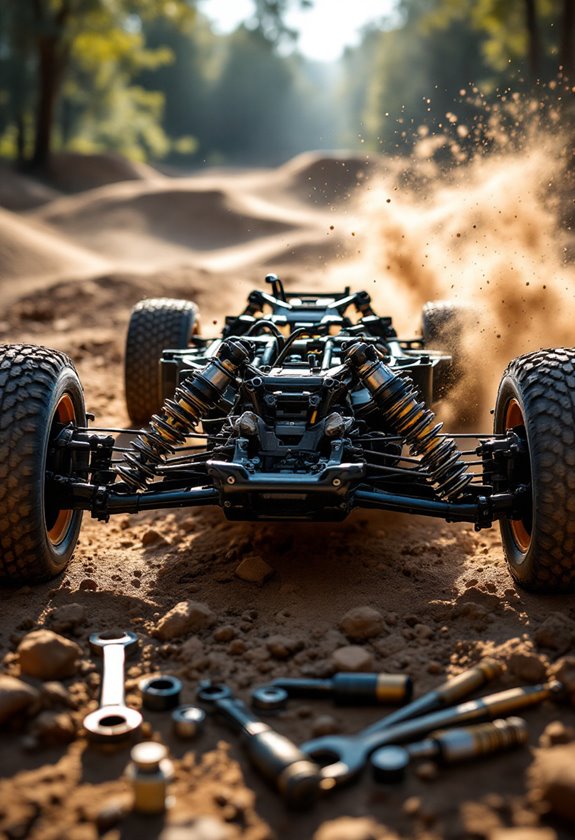
To tune our RC off-road car’s performance, we should start by fine-tuning gear ratios for desired speed and torque. Next, we adjust the suspension setup for terrain challenges, focusing on ride height, camber, and toe settings. We’ll also select the right shock oil weight for our conditions and choose tires that match the surfaces we’ll be driving on. Finally, tweaking aerodynamics can boost speed and handling. Stick around, and we’ll cover each step in detail!
Key Takeaways
- Adjust gear ratios for a balance of top speed and torque based on your terrain needs.
- Fine-tune suspension setup by modifying ride height and shock oil thickness for optimal terrain response.
- Optimize caster and camber angles for improved stability and cornering performance on varied surfaces.
- Choose appropriate tire compounds and tread patterns to match the specific terrain conditions you encounter.
- Utilize aerodynamic enhancements like spoilers and ground effects to reduce drag and increase grip during runs.
Understanding Gear Ratios for Off-Road Performance
When diving into the world of off-road RC cars, understanding gear ratios is essential for tuning performance. Gear ratios reflect the relationship between the pinion and spur gears, calculated by dividing the number of teeth on each gear. For example, if we have a 100-tooth spur gear and a 20-tooth pinion, the gear ratio is 5:1.
Higher gear ratios can increase top speed but reduce torque, making quick acceleration harder. Conversely, lower ratios boost torque, great for steep climbs and rough terrain. To optimize our performance tuning, we should consider these factors:
- Desired speed vs. torque needs
- Off-road conditions
- Manufacturer recommendations
- The selection of batteries with high discharge rates can also significantly impact overall vehicle performance.
Adjusting Suspension Setup for Terrain Challenges

To tackle off-road terrain challenges effectively, adjusting our suspension setup is essential. Start with ride height; a higher setting gives better ground clearance for rough surfaces, while a lower one lowers the center of gravity for smooth tracks. Next, consider shock absorber performance. Thicker shock oil increases damping for bigger impacts, while thinner oil provides quicker responses on smoother terrain. We should also pay attention to droop settings—more droop helps the wheels stay connected to uneven ground. Finally, check the camber angle. Negative camber improves grip on slippery terrain, while less maintaining responsive handling. Balancing these suspension tuning basics helps maximize our car’s performance, tailoring it to the specific challenges we face on the track! Additionally, incorporating high-quality shock absorbers enhances overall stability and responsiveness during off-road driving.
Recommended Products

Give your Tacoma the Perfect Blend of Performance, Protection, and Style from Rough Country.

Give your Suburban/Tahoe/Yukon 1500 the Perfect Blend of Performance, Protection, and Style from Rough Country.

Give your Silverado/Sierra 2WD the perfect blend of performance, protection, and style from Rough Country.
Optimizing Caster and Kick-Up Angles

Optimizing our caster and kick-up angles can greatly enhance our off-road car’s performance, especially when we consider the specific terrains we’ll encounter. For caster angle adjustments, we generally find that a positive caster stabilizes steering on bumpy tracks, but too much can make steering heavy. It’s a balancing act! When we look at kick-up optimization, increased angles help with bump absorption, while lesser angles can improve steering responsiveness on smoother surfaces. Remember, moderate settings can provide a good compromise for varied conditions. Ultimately, tuning these angles allows for stability tuning and handling balance that enhances our car’s terrain adaptability, keeping us in control while steering through diverse off-road challenges. Your adjustments will make a noticeable difference! Additionally, the use of 2.4GHz technology in your RC car transmitter can further improve your control and range, complementing your tuning efforts effectively.
Recommended Products

Give your Super Duty the Perfect Blend of Performance, Protection, and Style from Rough Country.

Features Stepped-V Shaped Main Chassis

Rough Country Control Arm Drop Relocation Kit (fits) 2003-2013 Dodge Ram 2500 3500 4WD 342 Control Arm Drop Kit
Selecting the Right Shock Oil Weight

Selecting the right shock oil weight is essential for tuning our RC off-road car to perform its best in various conditions. When we talk about shock oil types, we must consider viscosity effects: lighter oils (25wt–35wt) allow faster suspension action, while heavier oils (45wt–60wt) provide better control during aggressive landings. It’s vital to balance oil temperature impact, as colder climates may require lighter oils for responsiveness.
For front rear balance, heavier oil in front shocks can control impacts, while softer oil in rear shocks enhances grip. Remember the oil selection guidelines specific to our vehicle class, adjusting for terrain adaptation. By fine-tuning shock oil, we optimize suspension dynamics, ultimately enhancing our car’s performance and handling over different terrains. Additionally, selecting the right suspension setups can significantly contribute to overall vehicle stability and cornering performance.
Recommended Products

Officially Licensed: Designed to look and perform just like the real trucks

The easiest, most convenient way to build a scale crawler for competition, with numerous innovations never before offered in a single comp-ready kit.

Rally-Ready Design: This 1/10 scale FAZER Mk2 FZ02-R features a licensed Subaru Impreza WRC 2002 body with plastic headlights, tinted clear windows, and an LED-ready light bucket. The new 15-spoke wheel design, high traction rally tires, and front bumper with skid angles ensure optimal performance on various terrains
Tire Choice for Different Surfaces

When it comes to maximizing our RC off-road car’s performance, tire choice plays a big role in how well we navigate different surfaces. Selecting the right tire compounds, like soft for loose dirt or hard compounds for turf tracks, helps us adapt to varying conditions. Tread patterns also matter; knobby tires dig into mud, while pin treads provide steering precision on mixed terrains. We should consider tire sizes too—larger tires improve obstacle clearance, but too big can affect handling. Finally, we must think about surface suitability and grip durability, often balancing performance and longevity. By understanding these factors, we can fine-tune our car for any track we encounter, ensuring we stay competitive and have fun! Additionally, choosing pre-glued tires can significantly simplify the installation process, allowing for quicker adjustments on different terrains.
Recommended Products

The ultimate 1/8 scale ARRMA buggy out of the box, with many laser-etched TLR Tuned parts.

Compatible With: The 1/5 RC tires compatible with Traxxas 1/5 X-MAXX 8S Arrma 1/5 Kraton 8S 1/5 Outcast 8S.

Sport - Harder, Long-Wear rubber compound
Tire Maintenance for Maximum Grip
To achieve maximum grip from our RC off-road tires, consistent maintenance is vital. First, we should perform tire cleaning regularly. Soaking our tires in warm water helps loosen dirt, but let’s steer clear of harsh chemicals that can damage the rubber. After washing, drying the tires thoroughly with a soft towel keeps moisture away.
Next, tire inspection is essential. Checking for cracks or uneven wear before each run guarantees our tires are safe and functional. We can also inspect the glue bond at the bead; it’s critical for keeping tires in place during high-speed action. Additionally, using high-quality rubber construction ensures that our tires provide optimal performance and durability. Finally, let’s remember to store clean, dry tires in airtight bags. This simple step keeps them in top shape for our next race!
Balancing Weight Distribution
After we’ve tackled tire maintenance to guarantee maximum grip, it’s time to focus on another significant factor influencing our RC off-road cars: balancing weight distribution. Proper weight shifting is essential for handling, stability, and traction. We should aim for a balanced setup that keeps all wheels in contact with the ground.
Centering the battery enhances stability during turns, while moving it toward the rear boosts rear-wheel grip. Additionally, securing heavy components low in the chassis lowers the center of gravity, improving cornering stability. We can even experiment with added weights for better high-speed stability, but let’s avoid overdoing it to prevent straining our motor and ESC. With careful balance tuning, we can enhance our vehicle’s performance on any terrain!
Choosing the Best Bearings and Upgrades
Choosing the right bearings and upgrades for our RC off-road cars can greatly enhance their performance on the track. To achieve speed increases, we can select ceramic bearings, which offer lightweight advantages, reduce friction, and resist deformation. However, steel bearings provide reliability at a lower cost. We should also prioritize quality bearing brands like ACER and Boca Bearings.
Regular inspection routines are essential, especially for motor and differential bearings. Applying proper lubrication techniques after each run can appreciably extend bearing life. Don’t forget to maintain a cleaning schedule to avoid grit buildup. By balancing our choices between ceramic and steel types, we can guarantee that our cars stay fast, responsive, and ready to tackle any terrain!
Recommended Products
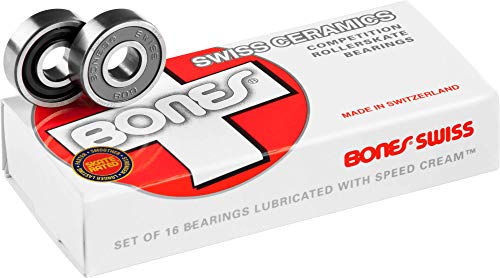
Bones Swiss Ceramics are in a class by themselves. If you want the best there is, this is it. The ceramic balls are much lighter, harder, stronger, waterproof, and longer lasting than the finest steel balls. Made in Switzerland.

TRAXXAS STAMPEDE VXL 4X4 1/10 ELEC OFF ROAD
TRAXXAS RUSTLER VXL COMPLETE 1/10 ELEC OFF ROAD
Fine-Tuning Ride Height for Stability
Fine-tuning ride height is essential for achieving stability in our RC off-road cars, especially as we navigate varying terrains. We start by making small ride height adjustments—around 2 mm at a time—to maintain a level chassis. A level chassis promotes consistent handling, enhancing our performance on various track surfaces. For rough terrain, we may raise the ride height to prevent bottoming out. To guarantee accuracy in our measurements, we should use a ride height gauge, allowing us to check and adjust from our baseline settings. Remember, as we tweak things like battery position, we’ll need to recheck our ride height for proper chassis leveling. Keeping everything properly aligned, we can truly enhance our car’s handling stability.
Camber and Toe Adjustments for Handling
When we think about improving our RC off-road car’s handling, proper camber and toe adjustments are essential. Camber adjustments involve tilting the wheels, ideally between -0.5° to -2°. This positioning enhances grip during corners by maximizing the tire patch. We can measure camber at ride height using a camber gauge for accuracy.
Next, we have toe settings, which dictate the angles of the front wheels. A slight toe-in helps straight-line stability, while toe-out can enhance corner responsiveness. Adjusting these angles by just 0.5° can greatly impact traction. Always aim for symmetry between left and right for balanced handling. By fine-tuning both camber and toe, we’re setting ourselves up for improved performance on the track!
Using Aerodynamics to Improve Speed
To enhance our RC off-road car’s speed, we can plunge into the world of aerodynamics, where every detail counts. First, let’s explore aerodynamic shapes; sleek designs reduce air resistance, boosting top speed, while bulky shells create drag, slowing us down. Next, we can make downforce adjustments using wings and spoilers, helping our tires grip the surface during sharp turns. Remember, oversized wings might block airflow, so balancing their sizes is key. Additionally, incorporating ground effects with skirts can optimize airflow, enhancing traction without adding drag. Ultimately, we’ll find the best balance between speed and handling by testing our modifications in various conditions. Together, we’ll achieve performance that’s finely tuned for our unique off-road adventures!
Testing and Refining Your Setup
Testing and refining our RC off-road car setup is essential for optimizing performance, especially as every tweak can lead to significant differences on the track. Start by establishing a baseline ride height of about 19 mm on all corners and measure it accurately using a proper setup station. From here, we’ll perform iterative testing; adjusting ride height can enhance stability on hard-packed surfaces or improve acceleration on loose terrain.
Log each change meticulously, focusing on specific handling issues, like reducing understeer or traction rolling. Remember, ride height affects everything—recheck it after suspension tweaks or battery repositioning. Together, we’ll fine-tune our setups, maximizing our handling and race day performance. Let’s hit the track!
Frequently Asked Questions
How Do Environmental Conditions Affect RC Car Performance?
It is understood that environmental conditions deeply affect our RC cars. Weather effects like heat or humidity alter battery life and performance, while terrain impact like mud and ice challenges traction, making each drive an adventure we navigate together.
What Tools Are Best for Tuning RC Cars?
Tuning an RC car’s like fine-tuning a musical instrument; we need the right tools. Performance meters, hex drivers, and suspension gauges are essential tuning tools for achieving precise adjustments and peak performance together on the track.
How Often Should I Inspect and Replace Tuning Components?
We should inspect tuning components every 2–3 runs, focusing on longevity. Regular checks guarantee ideal performance and prevent issues. Keeping track of these intervals helps us maintain our cars’ responsiveness and enjoyment on the track.
Can I Use My RC Car for Different Terrains?
Absolutely, we can embrace various terrains with our RC cars! Their terrain adaptability and surface compatibility let us explore dirt, gravel, and rocks together, creating unforgettable adventures while we push our vehicles to their limits.
What Safety Precautions Should I Take While Tuning?
While tuning, we should prioritize tuning safety by wearing goggles, gloves, and closed-toe shoes. We must also avoid fire hazards by letting hot components cool and keeping flammable materials away from our workspace.