As an Amazon Associate, we earn from qualifying purchases. Some links on this site are affiliate links at no extra cost to you. Our recommendations are based on thorough research and editorial judgment.

How To Tune RC Monster Truck For Jumping?

To tune your RC monster truck for jumping, let’s focus on key areas. Start with suspension setup—use 50-60 WT oil and increase spring preload for better stability. Properly prepare tires by cleaning and adjusting pressure for ideal grip. Design ramps at a 35° angle, ensuring they’re about 1500mm long for stability. Maintain steady speed and modulate throttle during jumps for control. Alter weight distribution and shock settings to enhance performance. There’s so much more to discover!
Key Takeaways
- Use 50-60 WT shock oil for effective absorption of landings and improved rebound performance.
- Increase spring preload to boost ride height, enhancing stability and reducing chassis damage.
- Adjust tire pressure and clean tires to optimize grip and shock absorption during jumps.
- Design and use ramps with a 35° angle and parabolic curve for better jump trajectory and control.
- Modulate throttle mid-air to maintain a level vehicle position for smooth landings.
Suspension Setup for Optimal Jumping Performance
When we think about tuning our RC monster truck’s suspension for ideal jumping performance, attention to detail is key. Let’s break down some essential factors:
- Shock Oil: Start with 50-60 WT oil for damping resistance to absorb landings.
- Spring Preload: Increase preload to raise ride height, aiding in landing stability.
- Mounting Positions: Outward mounts improve jump control, while inward mounts soften the feel.
- Ride Height: Higher ride height prevents chassis damage and supports smoother landings.
- Piston Size: Larger holes in the pistons speed up fluid flow, enhancing rebound and reducing pack-up.
Additionally, consider advanced suspension systems which can further improve traction and handling during jumps.
Recommended Products

Loaded with EXB (Extreme Bash) upgrades for stunt-ready toughness

Upgraded with EXB (Extreme Bash) parts for no-fear toughness

【Officially Licensed Ford Bronco Baja 1000 Design】Fully licensed by Ford and RTR Vehicles, featuring two iconic Baja 1000 liveries from 2024 and 2025—perfect for collectors and hardcore off-road fans.
Tire Preparation and Traction Management

To achieve ideal traction and performance from our RC monster truck, tire preparation and management are absolutely essential. First, let’s focus on tire cleaning. We should clean our tires thoroughly using dedicated sprays that suit foam or rubber types. Massaging the cleaner into the surface and wiping it off guarantees consistent grip.
Next, let’s talk about tire pressure. Lower pressures offer better shock absorption, while higher pressures improve roll resistance. It’s vital to find a balance that suits our jump style. We recommend checking tire pressure regularly, as it can change due to temperature or use.
Finally, consider using tire sauces for break-in, allowing them to soften and enhance grip. Keeping our tires in top shape is key for successful jumps! Additionally, selecting multiple terrain tires can enhance adaptability, ensuring optimal performance across various surfaces.
Recommended Products

Drive adventures in the light or in darkness with the Hot Wheels Monster Trucks 1:15 scale Gunkster RC!

Upgrade your RC monster truck with these high-performance 3.8" MT tires! Designed for extreme off-road adventures, these tires come pre-mounted on durable multi-spoke wheels and include foam inserts for superior cushioning and traction.
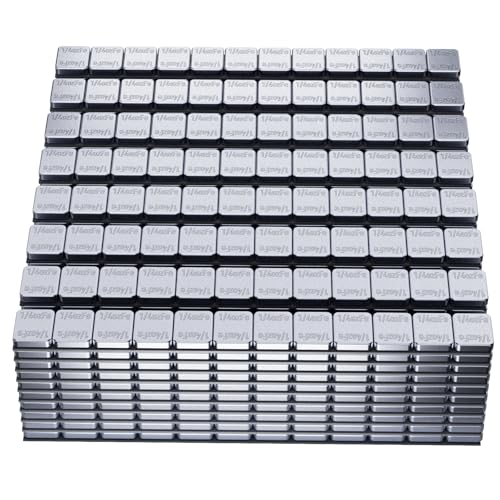
Specification: 1 segment: 1/4 oz 1 strip=12 segments 1 box=4 strips=48segments=12oz in total
Designing Effective Ramps for Jumps
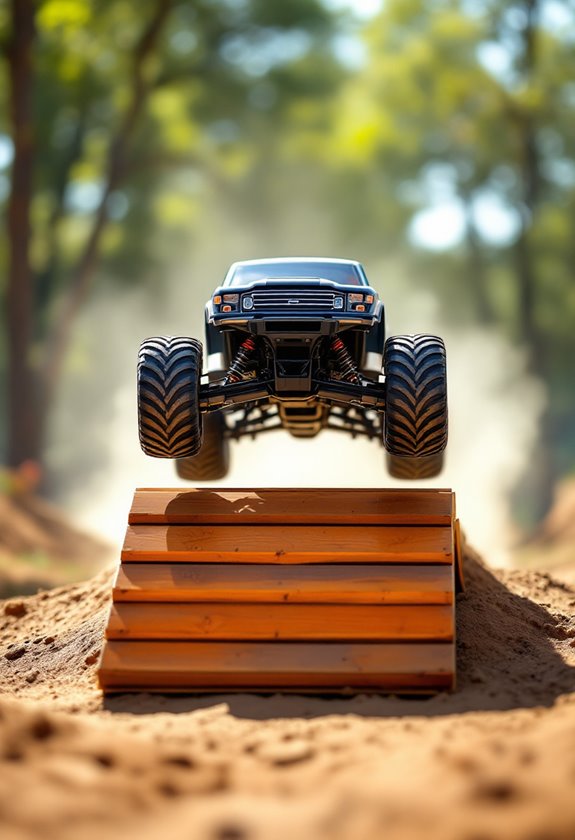
Often overlooked, the design of ramps plays an essential role in the performance of our RC monster trucks during jumps. For effective jumps, the ideal jump angle is around 35°. Ramps need to be around 1500mm long for monster trucks, with widths of about 40 inches for stability. We recommend using 6mm plywood for side panels and 4mm plywood for the curved surfaces. This guarantees durability and prevents flex. To prevent nose-dives, avoid steep angles. Instead, opt for a parabolic curve to aid flight trajectory. Adding support beams beneath the ramp helps minimize bounce during landings. Finally, always sand the surfaces smooth to protect our trucks from splinters and damage! Additionally, incorporating customizable lighting options can enhance visibility during jumps, especially in low-light conditions.
Recommended Products

TRUCK RAMP - AFF's Super Heavy-Duty truck ramps have a 20 Ton capacity per pair and comes in a pair
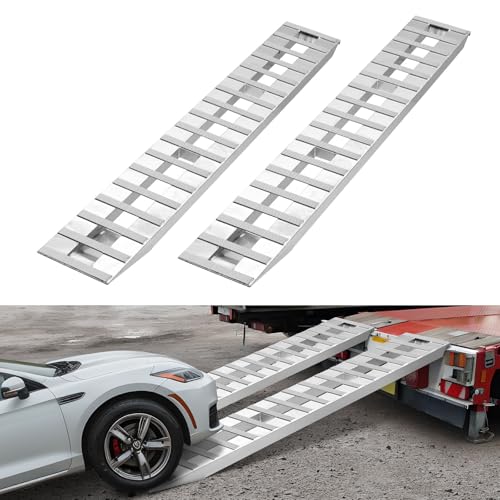
10,000 Lbs Weight Capacity: This extended truck loading ramp set supports up to 10,000 lbs combined. Each ramp measures 108 x 15 in, fits tires up to 14 in wide, and provides a longer, gentler incline, ideal for tractors, ATVs, lawn mowers, motorcycles, and more

Protect Your Floors: Engineered with a special construction that guarantees no scratches or marks on your flooring, ensuring your workspace stays pristine
Enhancing Ramp Surfaces for Realism and Grip
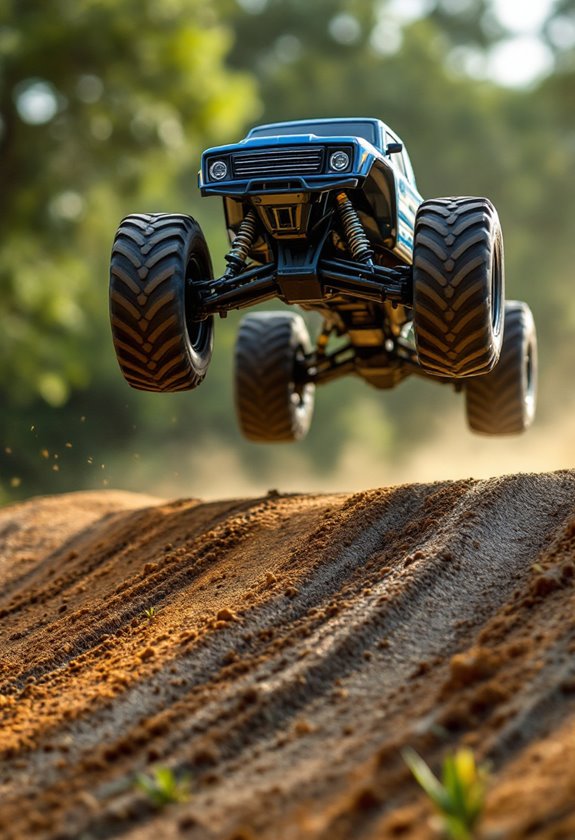
Enhancing ramp surfaces goes beyond just aesthetics; it plays an essential role in how well our RC monster trucks perform. To improve our jump experiences, we can apply various surface texturing techniques. Using short-pile carpet, for instance, not only absorbs shocks but also enhances traction. Rubber mats offer durable, non-slip surfaces, ideal for both indoor and outdoor setups. Fine-grained sandpaper can be applied to boost grip on inclines. We can also utilize anti-slip adhesive films for adaptable traction enhancements on ramps. For added realism, we might roll our truck’s tires through mud-colored acrylic paint, creating a visually appealing and functional surface. Incorporating these elements guarantees we’re maximizing both our performance and enjoyment while jumping! Additionally, investing in high-capacity batteries can significantly enhance the power output of our trucks during jumps.
Mastering Driving Techniques for Controlled Jumps

Mastering driving techniques for controlled jumps is vital for getting the most out of our RC monster trucks. To nail our jump approach, we should target a steady speed before the ramp—too much throttle too late can cause the nose to pitch up uncontrollably. A good starting point is using just over 50% throttle on mild ramps, helping us maintain control in the air. While airborne, throttle modulation allows us to adjust the nose angle; more throttle lifts the truck, while brakes lower it. It’s essential to keep the vehicle level during flight for smoother landings. By practicing these techniques, we’ll improve our jump consistency and enhance our overall drive experience. Additionally, understanding the importance of multi-terrain capability can help us select the best surfaces for jumps to maximize performance. Let’s get our skills to new heights!
Adjusting Vehicle Parameters for Jump Performance
Understanding how to adjust vehicle parameters can considerably enhance our jumping performance. First, we should focus on weight distribution; shifting weight forward helps prevent nose-up pitch in mid-air, leading to improved landings. Next, let’s make shock adjustments. Using thicker oil in our shocks enhances damping on hard landings, but thinner oil allows for faster rebounds, essential for smoother takeoffs. We can also adjust spring stiffness, opting for softer springs that improve shock absorption while being cautious of handling stability. Additionally, lowering the ride height slightly reduces the center of gravity, enhancing both takeoff and landing stability. By maintaining ideal weight within chassis specs, we optimize responsiveness. Regular maintenance of our shocks, including fluid checks, keeps performance consistent. Moreover, ensuring your truck has a high-quality suspension system is vital for handling rough surfaces effectively.
Recommended Products

Longer 15" wheelbase with shock mountable lower 4-link bars.

Extreme Velineon VXL-4s ESC with 540XL Brushless Motor

Velineon VXL-3s speed control with oversize 540XL brushless motor for extreme power
Fine-Tuning Your Monster Truck for Individual Preferences
When we talk about fine-tuning our monster truck for individual preferences, we’re looking at a variety of specific adjustments that can make a big difference in performance. First, we can adjust shock oil viscosity—thicker oil slows rebound, while softer oil speeds it up. Next, swapping springs can alter ride quality; softer springs absorb jumps better, while stiffer springs provide landing stability. Tire choice is vital too; selecting the right compound guarantees traction on different terrains. Additionally, tweaking wheel alignment, like adjusting camber angles, can enhance steering and stabilize landings. Finally, we’ll want to take into account electronic tuning for throttle response. Always remember, focusing on our driving preferences while implementing safety measures is essential for an enjoyable ride!
Recommended Products

The ultimate ARRMA 1/5 scale ready-to-run Speed Monster Truck

Officially Licensed: Designed to look and perform just like the real trucks

Detailed scale looks with three factory-finished body color choices
Frequently Asked Questions
What Tools Do I Need for Tuning My RC Monster Truck?
Did you know that 70% of RC enthusiasts believe tuning techniques enhance performance? For our tuning, we need essential tools like screwdrivers, calipers, and shock pliers to elevate our monster truck experience together. Let’s get started!
How Often Should I Replace the Shock Oil?
We recommend replacing shock oil every 5 to 10 runs for bashers and after each race day for competitive drivers. Different shock oil types affect performance, so regular oil change frequency keeps our rides performing at their best.
What’s the Ideal Weight for My Monster Truck Setup?
Finding our ideal weight for the monster truck’s setup is like balancing a tightrope; we should aim for a harmonious weight distribution to enhance suspension tuning, ensuring stability and smooth landings during our thrilling jumps and adventures together!
Should I Avoid Jumps in Wet Conditions?
Yes, we should definitely avoid jumps in wet conditions. Our jumping technique suffers on wet surfaces, leading to loss of control and potential damage. Let’s stick to dry environments for safer, more enjoyable jumps together!
How Can I Tell if My Tires Need Replacing?
Think of our tires as the heartbeat of our RC truck. When tread depth diminishes or tire wear shows cracks, it’s time to replace them. Let’s keep our rides safe and thrilling together!